Alternate TextTo enhance service speed and avoid tariff delays, we've opened a US warehouse. All US orders ship directly from our US facility.
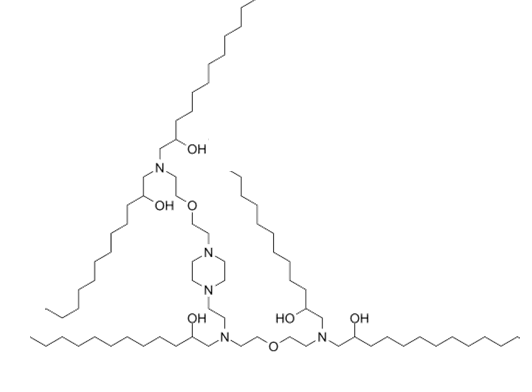
C12-4 (Lipid A-4,Lipid F3)

  Cat. No.:  DC89101   Featured
Chemical Structure
2639634-71-0
For research use only. We do not sell to patients.
We match the best price and quality on market.
Email:order@dcchemicals.com  sales@dcchemicals.com
Tel:+86 21 58447131
We are official vendor of:
  • 20
  • 19
  • 18
  • 17
  • 16
  • 15
  • 14
  • 12
  • 11
  • 10
  • 9
  • 8
  • 13
  • 6
  • 5
  • 4
  • 3
  • 2
  • 1
More than 5000 active chemicals with high quality for research!
Field of application
C12-4 (Lipid A-4,Lipid F3) is a branched-chain ionizable cationic lipidoid that has been used in the formation of lipid nanoparticles (LNPs) for the delivery of mRNA. LNPs containing lipid A4 and encapsulating an mRNA reporter accumulate in the uterus, placenta, and ovaries, as well as to the spleen and liver, in pregnant mouse dams unlike LNPs containing the branched-chain ionizable cationic lipidoid C12-200, which primarily accumulate in the liver. Intravenous administration of LNPs containing lipid A4 and encapsulating mRNA encoding VEGF increase placental VEGFR1 levels and mean fetal blood vessel area without inducing liver damage in pregnant mouse dams.
Cas No.: 2639634-71-0
Chemical Name: C12-4 (Lipid A-4)
Synonyms: 2-Dodecanol, 1,1′-[[2-[2-[4-[2-[[2-[2-[bis(2- hydroxydodecyl)amino]ethoxy]ethyl](2- hydroxydodecyl)amino]ethyl]-1-piperazinyl] ethoxy]ethyl]imino]bis-,C12-4 (C12-494,Lipid A-4) ;C124, C12 4
SMILES: CCCCCCCCCCC(O)CN(CCOCCN(CC(O)CCCCCCCCCC)CC(O)CCCCCCCCCC)CCN1CCN(CCOCCN(CC(O)CCCCCCCCCC)CC(O)CCCCCCCCCC)CC1
Formula: C74H153N5O7
M.Wt: 1225.04
Purity: >95%
Sotrage: -20 C
Publication: 1. Swingle, K.L., Safford, H.C., Geisler, H.C., et al. Ionizable lipid nanoparticles for in vivo mRNA delivery to the placenta during pregnancy. J. Am. Chem. Soc. 145(8), 4691-4706 (2023). 2 Kim D, Moon SJ, Han EL, Feng E, Murray AM, Wang J, Liu W, Kong G, June CH, Mitchell MJ. HITE: HIV Inspired Lipid Nanoparticle Platform for CAR T Cell Engineering. Nano Lett. 2026 Apr 21.
Description: Lipid A4 (C12-4) is a branched-chain ionizable cationic lipidoid that has been used in the formation of lipid nanoparticles (LNPs) for the delivery of mRNA. LNPs containing lipid A4 and encapsulating an mRNA reporter accumulate in the uterus, placenta, and ovaries, as well as to the spleen and liver, in pregnant mouse dams unlike LNPs containing the branched-chain ionizable cationic lipidoid C12-200, which primarily accumulate in the liver. Intravenous administration of LNPs containing lipid A4 and encapsulating mRNA encoding VEGF increase placental VEGFR1 levels and mean fetal blood vessel area without inducing liver damage in pregnant mouse dams.
References: 1. Swingle, K.L., Safford, H.C., Geisler, H.C., et al. Ionizable lipid nanoparticles for in vivo mRNA delivery to the placenta during pregnancy. J. Am. Chem. Soc. 145(8), 4691-4706 (2023).
Cat. No. Product name Field of application
DC89101 C12-4 (Lipid A-4,Lipid F3) C12-4 (Lipid A-4,Lipid F3) is a branched-chain ionizable cationic lipidoid that has been used in the formation of lipid nanoparticles (LNPs) for the delivery of mRNA. LNPs containing lipid A4 and encapsulating an mRNA reporter accumulate in the uterus, placenta, and ovaries, as well as to the spleen and liver, in pregnant mouse dams unlike LNPs containing the branched-chain ionizable cationic lipidoid C12-200, which primarily accumulate in the liver. Intravenous administration of LNPs containing lipid A4 and encapsulating mRNA encoding VEGF increase placental VEGFR1 levels and mean fetal blood vessel area without inducing liver damage in pregnant mouse dams.
DC86601 Lipid 8 Lipid 8 iLNPs were used to deliver CRISPR-Cas9 mRNA and sgRNA which targeted to the PLK1 gene. The safety and excellent intracerebral diffusion performance of lipid 8 iLNPs ensured that the survival of murine glioblastoma multiforme (GBM) mice was extended. The median survival was extended by approximately 50% and the overall survival was increased by 30%. The treatment of metastatic adenocarcinoma was executed by the EGFRtargeted lipid 8 iLNPs. These iLNPs possessed the ability of tumor targeting, which could increase the accumulation of CRISPR-Cas9 mRNA and sgRNA within the tumor cells. After a single intraperitoneal administration, 80% PLK1 gene was edited and the overall survival of mice with high-grade ovarian cancer malignant ascites was enhanced by 80% . These results demonstrate the clinical potential of CRISPR-Cas9 gene editing system can be delivered by iLNPs for treating tumors, and provide new ideas for tumor gene therapy.
X